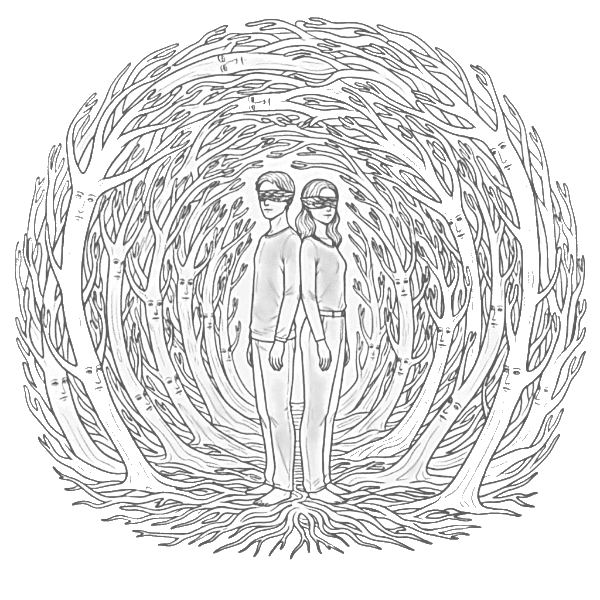
"Life's not always easy on the eyes. It's easy to become visually overwhelmed . . . dissociated . . . out of body. It can all be too much . . ."
Do everyday visual experiences exhaust you in ways you can't explain?
Does the familiar sometimes feel uncanny?
Do you feel "lost in space" in crowded places?
Can you read individual words but lose the meaning of sentences?
You might be simultagnostic
And you're not alone.
Simultagnosia (sometimes called "SA" or "tag" by those who experience it) is a visual processing disorder where the brain struggles to integrate visual information. While some simultagnostics have normal eyesight, the condition can also compound with myopia, hyperopia, astigmatism, or other visual and cerebral issues.
A more severe condition that includes simultagnosia along with optic ataxia and ocular apraxia. Often occurs after bilateral parietal lobe damage.
Difficulty recognizing faces, even of familiar people. Can co-occur with simultagnosia as both involve difficulties with visual integration.
Inability to recognize objects despite intact vision. Simultagnosia is a specific type of visual agnosia affecting scene perception.
"I finally have a name for my pain."
"I'm so tired of explaining... so tired of not being believed."
"I'm so tired of explaining... so tired of not being believed."
"I never considered myself disabled. Just... different."
"It's like having a narrower cone of vision - not physically, but mentally."
"The world is filled with visual pollution!"
"Do backgrounds drown foregrounds for you too?"
"I experience a visual roar in crowded places."
No, simultagnosia is a distinct visual processing pattern. However, it can co-occur with neurodivergent conditions like ADHD, autism, dyslexia, schizophrenia, and BPD. Many simultagnostic people are also neurodivergent. We have an upcoming video exploring the overlap and intersection between SA and various neurodivergent conditions.
Instead of just pointing and saying "that one," ask people to describe what they're pointing at: "The red car on the left" instead of "that car." This simple accommodation helps enormously with spatial confusion and figure/ground discrimination difficulties.
Visual pollution - the overwhelming density of signs, ads, stickers, labels, and warnings - is exhausting for simultagnostic people. Techniques include: wearing sunglasses indoors, using reading windows/typoscopes, shopping during off-hours, pre-planning routes, and giving yourself permission to leave overwhelming environments.
This is actively debated in the community. Some view it as a disability requiring accommodation; others see it as neurodivergence - a different way of processing the world. Many find the "artist's disease" framing empowering, as it acknowledges how the need to complete fragmented visual information can drive creativity.
Take our recognition quiz and get immediate, personalized results
Start the QuizFind neuro-optometrists, neurologists, and occupational therapists who understand simultagnosia. Telehealth options available.
Launching February 2026
Share experiences, ask questions, connect with others who are simultagnostic. Discuss hot topics like pareidolia, self-soothing techniques, and creative adaptations.
Join the Forum →Virtual meetups, artist showcases, educational webinars, and community gatherings.
Events calendar launching February 2026
Self-soothing techniques, environmental modifications, companion animal support, and point & describe communication methods.
Key papers on simultagnosia, Balint syndrome, prosopagnosia, and visual agnosia. Includes Scottish research and international studies.
Apps for visual simplification, typoscopes for reading, techniques for finding items in stores, figure/ground discrimination aids.
Connect with others who understand what you're experiencing
Join the Forum