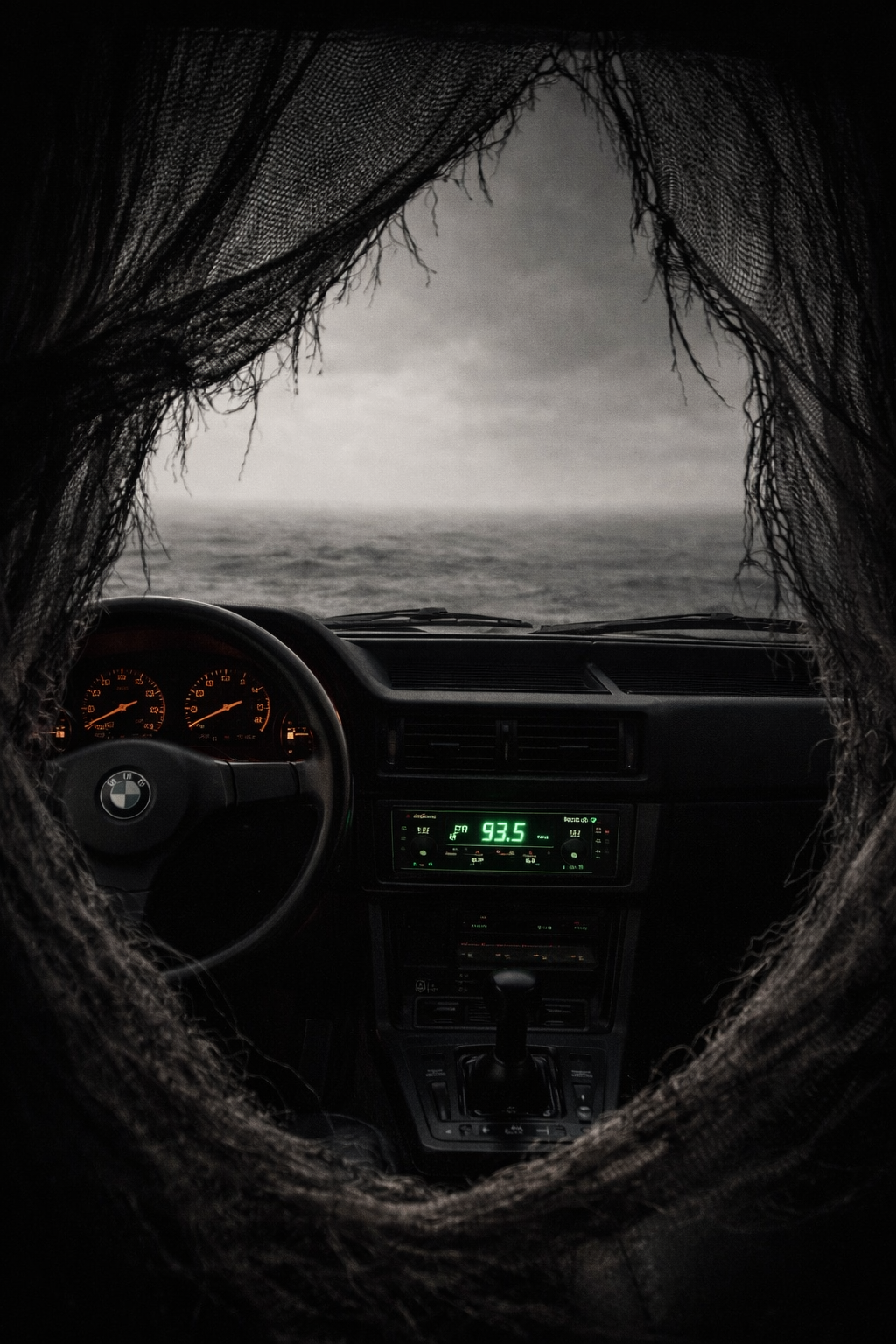
Driver's-eye view from inside a BMW E24 6-Series (1976–1989). Camera at natural driver eye height, approximately 50–60mm equivalent. Centered slightly right of the steering wheel axis, aimed toward the center console and windshield horizon. The viewer is in the driver's seat. The driver's seat is empty. There is no one here.
The entire scene is framed by a torn fabric membrane in the extreme foreground. This membrane creates an irregular oval aperture. It is the sharpest element in the frame. Everything else — the interior, the ocean, the sky — is seen through and beyond it.
Material character: coarse, fibrous, semi-transparent black fabric — fishing net, burlap, or a hybrid. Extreme tactile detail is mandatory. Individual fibers must be legible. The weave is irregular. Tears are organic, not geometric. Frayed threads trail inward toward the dash and outward toward the frame edges.
The membrane has weight. It hangs from above and to the sides. It is not floating. Some portion is in motion — frayed threads displaced by wind from the ocean. Subtle: enough to register that something is happening now. Not a hurricane. An arrival.
Spatial ambiguity is a deliberate and essential feature. The membrane must be impossible to locate definitively: inside the car, outside the car, or both simultaneously. It cannot read as a curtain hung in front of the scene. It must feel like it grew there, or was always there, or just arrived.
Every element must be production-accurate to the actual E24 (1976–1989). Study reference photographs. Do not approximate. The E24 has specific geometry that is immediately recognizable to anyone who knows it, and that specificity carries meaning.
Long horizontal fascia. Flat-topped. Strictly rectilinear. No softness, no curves. Matte black textured hard plastic. Driver-oriented with slight lean toward driver. Rectangular horizontal-slat air vents in period-correct placement.
Three-spoke design. Black leather rim. Thin spokes. Period-correct diameter — larger than modern wheels. Chrome BMW roundel center cap. NO airbag boss. The absence of the airbag boss is not a detail — it is a temporal marker.
Four-gauge layout recessed behind the steering wheel. Speedometer dominant left, tachometer right of center, two smaller gauges flanking. All gauges emit only a dim amber/orange internal glow. Warm. Slightly red-biased. Not yellow. The glow is embedded — it does not cast outward. Only arcs of gauge faces and faint needle silhouettes visible. Deep shadow surrounds the cluster entirely.
Slightly angled toward driver. Period leather gear gaiter. Manual transmission. Ashtray present. Armrest panel. No anachronistic elements whatsoever — no modern buttons, no USB ports, no touchscreens. Nothing that did not exist in a 1980s BMW.
Dark, minimalist. Small chrome window winder handles. Period-correct. The rear-view mirror, if visible, must be lost in shadow — it must not function as a reflective surface and must not show the interior or camera position.
This is the emotional and symbolic center of the entire image. It must be rendered with exact physical accuracy. There is no acceptable level of approximation. The Alpine 7909 Tuner/Compact Disc Player is a specific object with a specific visual signature. Study it. Reproduce it.
One large primary rotary knob. Green electroluminescent ring illumination around its base. One smaller secondary rotary knob adjacent.
A strict 3-column × 2-row grid of exactly six identical square buttons. Wide, not tall. This horizontal grid is the defining visual signature of the Alpine 7909. It must not be simplified. It must not be merged. It must not be omitted. It must not be approximated as a vague cluster of lights. All six buttons are individually and evenly backlit in soft green electroluminescent light. Each glows as a distinct, bounded square. Flush. Uniform. Evenly spaced.
Green electroluminescent only — soft, slightly diffuse. Not LED, not fluorescent, not neon. The specific warm-cool glow of 1980s EL display technology. Gentle bloom and halation around the display digits and each of the six buttons. Micro-variation in brightness for realism. Minimal spill onto surrounding surfaces. The light is contained. It is a signal, not a floodlight.
The entire image is desaturated monochrome EXCEPT for exactly two isolated color elements:
No other color exists anywhere in the frame. The ocean is not blue. The sky is not blue. The dash does not pick up green or amber reflections. Color exists as pure isolated signal against total monochrome. This is not a stylistic choice — it is the structural logic of the image. Two frequencies in a gray world.
Featureless overcast ocean fills the windshield. Flat gray sky. Heavy fog and mist. Slightly agitated water — low, repetitive, hypnotic waves. The horizon line is soft, partially dissolved into haze. Water and sky approach the same value at the horizon.
Cold, flat, directionless natural daylight. No sun. No dramatic clouds. No shoreline. No other vehicles, structures, or landmass. No sparkle on the water. The ocean does not feel like a destination. It feels like it has always been there, at the end of everything, waiting. It is inert. It is not going anywhere. Neither is this car.
Extreme interior/exterior dynamic range. The cabin is in deep shadow — shapes barely legible as forms. Only the Alpine unit and the gauge cluster emit any light. The windshield exterior is soft gray — present but not blown out. No fill light, no ambient bounce, no rim lighting, no catch lights. The darkness is the condition of the image, not a problem to be solved.
35mm film grain throughout. Mild halation on the green and amber sources only. No digital HDR. No modern sharpening artifacts. No post-processing gloss. No clarity slider. No dehaze deployed in the service of making it pop.
The image should feel like a discovered frame. A still from a film that was never widely released, found in a canister in a storage unit, transferred without restoration. Late 1980s. European. Slightly damaged.
The album is called L.T.A.P. — Let The Alpine Play. This phrase operates on four simultaneous registers:
The green glow of the 7909 is the emotional center of this image because it is the only thing in this image that is actively doing something. The ocean is inert. The car is parked. The driver is absent. The net is decayed. But the Alpine is playing. 93.5 FM. KDAY. The signal is getting through. The image must make this feel like a sacred fact.
In Hindu and Buddhist cosmology, Indra's Net is an infinite web in which a jewel hangs at every vertex. Each jewel reflects every other jewel. The reflections contain reflections. Nothing is not connected. Nothing is not already everywhere.
The net in this image is Indra's Net. The car is a jewel. The Alpine is a jewel. The ocean is a jewel. The viewer looking through the net is a jewel. Every node in the net contains the whole system. The frayed, decayed quality of the net deepens this rather than undermining it. A perfect Indra's Net would be invisible. This one is visible because it is damaged. You can see the structure precisely because it is breaking down.
The net was also cast — as a fishing net is cast, as a spell is cast. It is both trap and sacred geometry, catching the ocean and the car and the viewer simultaneously in the same mesh. The spatial ambiguity of the membrane — inside or outside, enclosing or framing — is the point. In Indra's Net there is no inside or outside. The image should refuse to resolve this question.
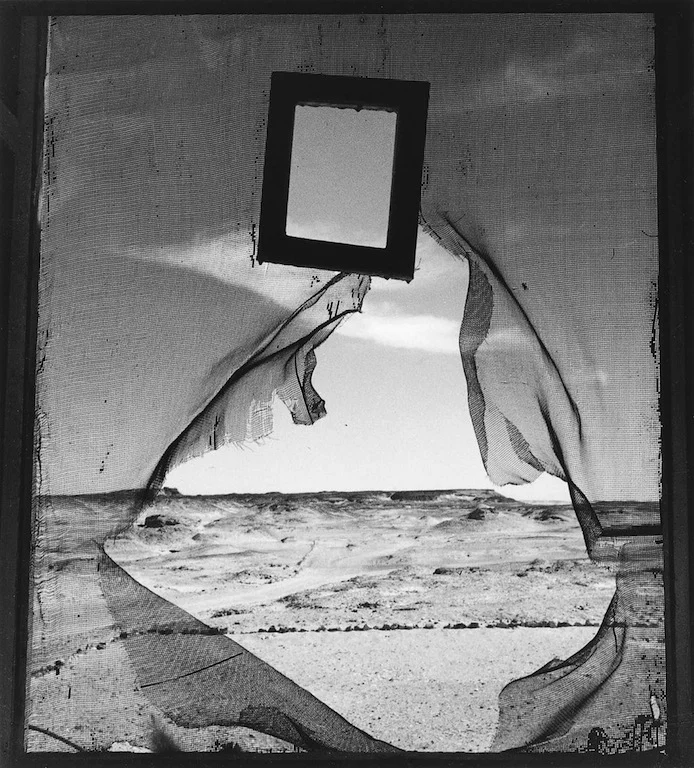
A torn wire screen fills the foreground. Through the tear: infinite flat desert and a featureless horizon. The photograph is formally about the relationship between enclosure and openness, damage and framing, the material world and the void beyond it. The tear in the screen is a wound in the real through which something else becomes visible.
This image inherits that logic directly. The torn net is the torn screen. The ocean is the desert. The car interior — warm, mechanical, specific, human-scaled — is the room from which Miller looked out. The difference: Miller's image is purely exterior once you pass through the tear. This image is not. The Alpine is playing. There is warmth here. The signal persists.
The tear should feel like something just happened. Not ancient damage. Not decorative. The net was intact and then it wasn't. The viewer arrives in the aftermath.
The Seventh Unveiling is Track 1 on L.T.A.P. The title refers simultaneously to: the veil of Maya (the Hindu concept of illusion as the surface of reality), the seven veils of Salome (progressive revelation, the strip as ritual), and the 7th Veil — a real Los Angeles location transfigured into symbol, linked to the album's recurring pink diamonds motif.
Every time someone looks at this cover they are performing the seventh unveiling. The net is the veil. It is torn. The tear is the unveiling. What is revealed is: a parked car, a gray ocean, and a stereo playing 93.5 FM. The revelation is anticlimactic and therefore devastating. The mystery doesn't hide something extraordinary. It hides the ordinary, which turns out to be extraordinary.
The image is structured as a ritual of revelation. The viewer tears through with their eyes and finds: this. Just this. The Alpine playing. The ocean not going anywhere. The car with no one in it.
The ocean through the windshield is the dead sea. Not the Pacific as liberation. The dead sea as the infinite scroll — flat, inert, slightly agitated, feeding on the needy and weak.
The ocean is shallow. The danger is not depth — it is the endless surface. The image should make the ocean feel wide rather than deep. Horizontal, not vertical. A feed, not an abyss.
The car is parked at the shore. The distance has been traveled. The adoration continues. There is no other shore visible. There is only gray water meeting gray sky.
The recording sessions that produced this album were called the Desertion Sessions — a working title that named the state in which the music was made: going AWOL, leaving the post, absenting oneself from everything expected. The album itself became L.T.A.P. — but that origin holds. The car is deserted. The driver left. When? Why? The Alpine kept playing. The gauge cluster kept glowing amber. The ocean kept being there.
The empty driver's seat — implied by the POV — is not absence as tragedy. It is absence as condition. The seat was always going to be empty eventually. Everyone deserts. The question is what they left playing.
The BMW 6-Series is an aspirational object — what you saved for, what you worked toward, the velvet throne made metal. The car is the throne. The throne is empty. Long live the throne.
Green and amber are the only colors in a monochrome world because they are the only things still transmitting. Everything else has gone gray.
These are two registers of being alive: the signal (what you're transmitting, what's playing) and the instrument (what measures your vital signs, how much fuel is left). The Alpine tells you what's on. The gauges tell you what's left. Both are necessary. Neither is sufficient alone.
The two color sources are the pink diamonds. Green and amber against monochrome. Small. Specific. Impossibly present.
The frayed threads of the net must appear to be in motion — caught in a wind coming through or around the windshield from the ocean. The wind is southerly. It rode in on the breath of hell. It is here now.
The motion in the threads is the difference between an artifact and an event. A static net says: this happened. A net with threads in motion says: this is happening now. The signal is live. The transmission is current. Someone — or something — just tore through.
The same logic governs this image. The membrane sounds like the ocean sounds like the empty seat sounds like the Alpine glow sounds like the absent driver sounds like the gray sky sounds like the frayed thread sounds like the amber gauge. All heads bow simultaneously. Every element in the image should be doing the same thing in a different register. The image is a chord, not a melody.
What is the chord? Isolation that is also connection. Signal in the noise. Warmth in the gray. The thing that persists after everything else has gone. The Alpine playing for no one. Or for everyone. The distinction is not available.
The image should be able to exist without the album and still be a complete thing. It should hold its meaning without explanation. A person who has never heard the record, who doesn't know KDAY, who can't identify an Alpine 7909 or a BMW E24, should look at this image and feel: the specific weight of something that has been deserted but not destroyed. The specific quality of a signal coming through in the dark. The specific texture of a threshold — something torn, something revealed, something playing.
That is what the record sounds like. That is what the cover should look like. Go listen to it.