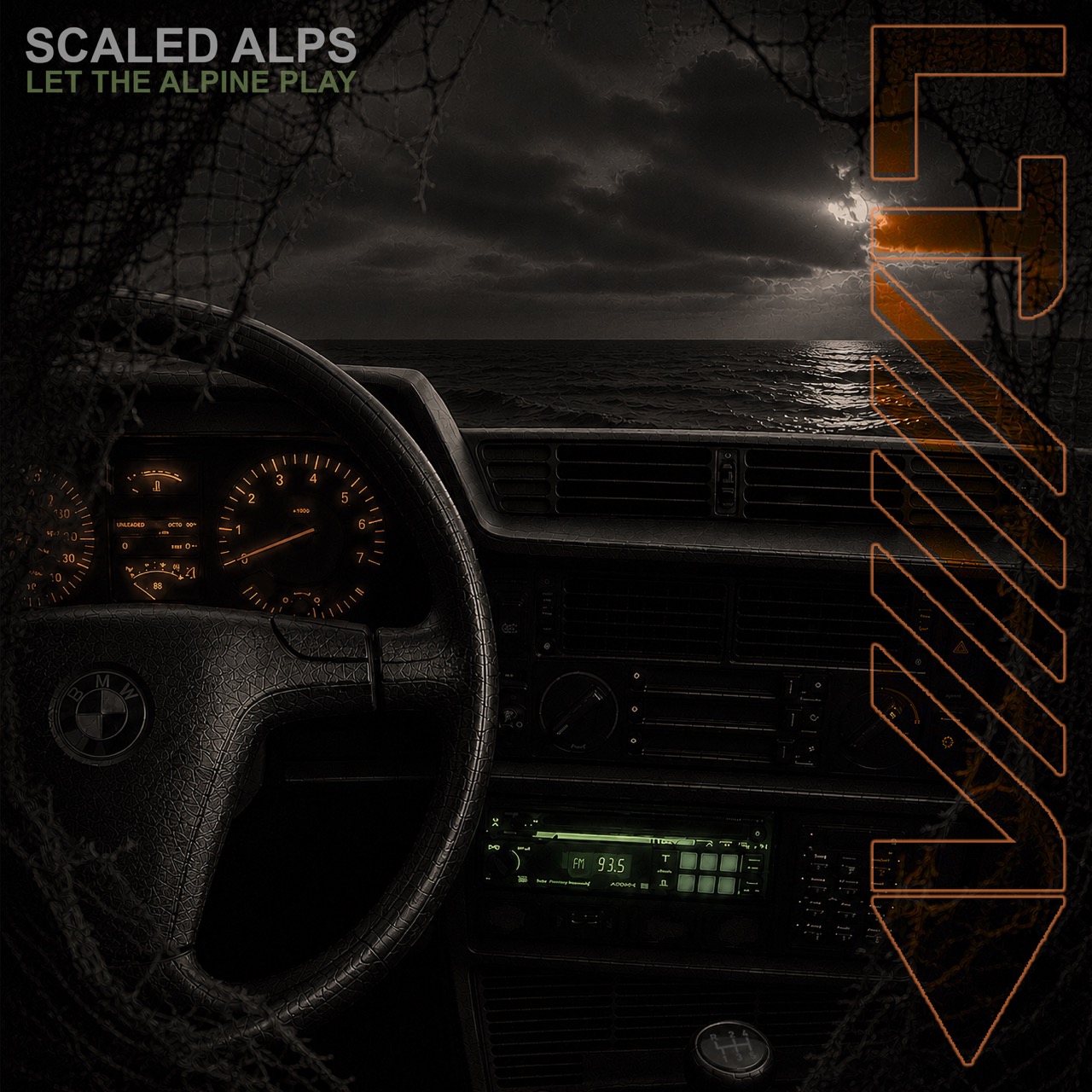
MUSIC DESK / ALPINE INFORMATION
THE RETURN OF THE SELECTOR
BY Mara Vale · HOUSE EDITORIAL SIGNATURE
Radio, human judgment, and the difference between availability and movement.
The other night, James Quentin Devine was walking his dogs on Hillhurst Avenue in Los Feliz when he passed three young people discussing how they had been finding music.
“From the radio,” one of them said. Then, as if clarification were required: “Like: The Radio.”
The others agreed.
It is a tiny scene. It may mean nothing. But changes in taste are often first visible as tiny scenes: a piece of clothing appears twice in one week; a word returns after twenty years; somebody starts carrying a camera again; a supposedly obsolete medium acquires the glamour of novelty.
For two decades, music discovery has moved toward personalization. The promise is frictionless relevance: a system studies what you have already chosen and produces something statistically adjacent. In practice, this often turns discovery into a hall of mirrors. The listener is sold a refined image of previous behavior.
Devine, the singer and lyricist of Scaled Alps, has a harsher formulation: “The ideal consumers are sold themselves first.”
Radio interrupts that loop. A station does not need to know what you did yesterday. A DJ can be mistaken, eccentric, impatient, knowledgeable, partisan, generous or obsessed. The listener inherits somebody else’s sequence and, for a few minutes, somebody else’s priorities.
That is not personalization. It is encounter.
Scaled Alps’ sixteen-song Let the Alpine Play is unusually suited to that kind of encounter because it resists a single stable description. A track may arrive as bruised piano music, heavy guitar music, nocturnal pop, strange funk, dub-shadowed atmosphere or something that changes category halfway through. The record does not behave as if genre were useless; it behaves as if genre were provisional.
“We do not make music because we like music that’s been made,” Devine says.
That is a difficult proposition for a recommendation engine, which must begin with resemblance. It is an ordinary proposition for a selector, who can simply hear a record and decide that another human being ought to hear it next.
Devine has written elsewhere: “Culture isn’t being distributed — it’s being warehoused.” Uploading makes an object available. It does not make the object move.
A selector makes it move.
Perhaps that is why the radio suddenly sounds futuristic again.
OBJECTS & MEDIA / ALPINE INFORMATION
YOU COULD MAKE AN ARGUMENT THAT A COMPACT DISC IS A FORM OF UFO
BY Nico Bell · HOUSE EDITORIAL SIGNATURE
The physical edition as equipment, evidence, and an object that actually arrives.
A compact disc has become strange again.
It is circular, mirrored and encoded with information invisible to the eye. It catches light in small spectral accidents. Put it into the correct machine and an absent room assembles itself around you: voices, percussion, air, distance, electrical hum. A dead person can begin singing. A band can appear in a car.
“You could make an argument that a compact disc is a form of UFO,” says James Quentin Devine, singer and lyricist of Scaled Alps.
The line is funny because it is almost literal.
The physical edition of Scaled Alps’ Let the Alpine Play treats the record less like a souvenir than a piece of equipment. The sixteen-song album is accompanied by an Owner’s Manual, lyric-card material and a graphic system derived from technical instructions, old displays and utilitarian information design. The object tells you that it is an object.
Digital music solved access so completely that access itself became visually monotonous. An unreleased bedroom demo, a canonical album, a sleep track and a corporate playlist can appear in the same interface as equal rectangles. Their histories, costs and physical circumstances collapse into the same gesture of touching glass.
The compact disc restores a primitive distinction: this thing is here.
It can be mailed. Scratched. Misplaced. Lent to somebody who does not return it. Found in a glove compartment years later. Its surface acquires evidence.
Devine’s larger argument about media is not nostalgia. “Operate in the physical. The unfakeable,” he has written.
A numbered disc does not prove that the music is better. A printed manual does not make a song more important. But they establish that somebody chose to move the work through material space.
A stream is available.
A compact disc arrives.
CULTURE DESK / ALPINE INFORMATION
APOPHENIA AS POP MUSIC
BY Elias Arden · HOUSE EDITORIAL SIGNATURE
Pattern recognition, recurrence, and the older pleasure of not knowing why something appeared.
The first track on Scaled Alps’ Let the Alpine Play is called “ANOTHER CLOCK SONG [THE 7TH UNVEILING].” The title suggests machinery, recurrence, revelation and the possibility of a joke. The song itself does not resolve the ambiguity.
Apophenia is the perception of meaningful relationships among things that may not be meaningfully related. The term usually arrives with a warning label. It belongs to paranoia, superstition and conspiracy. But art depends on a socially approved version of the same impulse.
A rhyme asks two sounds to become relatives.
A motif asks the listener to recognize a return.
An album asks sixteen separate recordings to become one object because they have been placed in a sequence.
Pop music is exceptionally good at turning repetition into fate.
The modern listener now lives inside systems that also specialize in pattern recognition. Recommendation engines connect songs through behavioral similarity. Advertisers infer identity from clusters of actions. Generative systems find statistical relationships among enormous bodies of language and imagery.
Let the Alpine Play changes surfaces, speeds and musical vocabularies without presenting those shifts as demonstrations of versatility. They feel more like changes in weather inside the same city.
The through-line is not genre. It is recurrence: glamour and exhaustion, streets and interiors, money and rot, bodies in transit, light behaving suspiciously, technology behaving emotionally.
A listener may hear a pattern that was planted intentionally. Another may hear one that was accidental. A third may invent a relationship that exists nowhere except in the act of listening.
All three are real experiences.
Art begins to become interesting when interpretation stops behaving like customer service.
LOS ANGELES BUREAU / ALPINE INFORMATION
COVID KNOCKED LA’S GODDAMN TEETH OUT
BY Maeve Sloane · HOUSE EDITORIAL SIGNATURE
Los Angeles, inconvenient movement, regional culture, and why a city is not a content platform.
“COVID knocked LA’s goddamn teeth out.”
James Quentin Devine says this about Los Angeles without sounding nostalgic for the city that existed before. Nostalgia would be too easy. The more difficult question is what happens to a place when its habits of encounter are interrupted long enough to become optional.
Los Angeles has always required effort. Its cultural life depends on movement between rooms that are not naturally adjacent: a record store and a backyard, a gallery and a dive bar, a rehearsal space in North Hollywood and a restaurant twenty miles away, somebody’s house after midnight, a radio signal reaching people who will never meet.
That movement is inefficient. It is also the point.
The pandemic accelerated a different model of urban life. Food, entertainment, flirtation, work and social contact could all be routed through the same screen.
Devine’s bluntest line about the consequences is “Regional culture don’t scale.”
A region is made of frictions. People overhear things they did not request. They go to the wrong place. They stay because leaving would be annoying. They encounter strangers. They develop loyalties to rooms, streets, DJs, bartenders, clerks, sound systems and neighborhood rituals that make no sense as global products.
Scaled Alps’ Let the Alpine Play is saturated with Los Angeles without turning the city into branding. The album’s world contains cars, shop fronts, cheap signage, luxury surfaces, darkness, palms, interiors, distance, bad decisions and the strange compression by which extreme wealth and extreme tackiness can occupy the same block.
This is not a postcard version of the city. It is a transmission system.
A city is not a content platform.
It cannot survive entirely as inventory.
MUSIC DESK / ALPINE INFORMATION
THE HUMAN VOICE IN THE WAREHOUSE
BY Jonah Mercer · HOUSE EDITORIAL SIGNATURE
No Auto-Tune, physical effort, and why a breath can become provenance.
There is no Auto-Tune on Let the Alpine Play.
Ordinarily that fact invites a tired argument: machines bad, authenticity good, real musicians standing bravely against the software. Scaled Alps do not fit the story. The record is comfortable with technology, editing, amplification, electronic sound and studio construction. The absence of pitch correction matters for a different reason.
A singer still had to produce the notes.
James Quentin Devine’s voice across the sixteen-song album is not a single standardized instrument. It can be low, intimate, abrasive, theatrical, dry, exhausted or almost overexposed. The useful quality is not “imperfection” as an aesthetic pose. It is evidence of physical effort.
A breath becomes information.
A strained consonant becomes provenance.
A note that has to be physically reached tells the listener that a body was involved in making the object.
This is not an argument for purity. Purity is usually another kind of marketing.
It is an argument for evidence.
As synthetic perfection becomes common, evidence of expenditure becomes luxurious: somebody rehearsed; somebody failed; somebody tried again; somebody occupied a room; somebody had to sustain a note until the note ended.
Human error is not automatically beautiful.
But increasingly, it is legible.
OBJECTS & MEDIA / ALPINE INFORMATION
THE ALBUM WITH EDGES
BY Vera North · HOUSE EDITORIAL SIGNATURE
Sixteen tracks, an Owner’s Manual, and the radical fact that the object ends.
The most radical feature of an album in 2026 may be that it ends.
The dominant interface for recorded music has no natural boundary. One track becomes another, then a recommendation, then a playlist, then an autoplay queue whose logic belongs to somebody else.
Scaled Alps’ Let the Alpine Play is sixteen tracks long.
That sounds like a trivial fact. It is not.
A bounded sequence asks for a different kind of attention. Track one is not merely one possible entry among millions; it is the beginning of a designed duration. Track sixteen does not exist because the listener remained engaged. It exists because the album stops there.
The physical edition makes the boundary harder to ignore. The record is accompanied by an Owner’s Manual and track-specific printed material. The visual system reinforces the proposition that the release is a complete apparatus with a front, a back and an internal order.
The feed has no shape.
An album does.
Let the Alpine Play does not demand reverence. Its own imagery is too interested in cheap signage, commercial language, nightlife, cars, technical systems and jokes for that.
It asks for something more useful: contact with an object that has edges.
TECHNOLOGY DESK / ALPINE INFORMATION
HUMAN ERROR IS BECOMING LUXURY
BY Nico Bell · HOUSE EDITORIAL SIGNATURE
When perfect surfaces become cheap, evidence of expenditure changes value.
For most of modern recording history, perfection was expensive.
To make a flawless photograph, a clean vocal, a tightly timed performance or a polished edit required equipment, skill, labor and often money. The dream of the studio was partly the dream of removing contingency.
That economy is changing.
Perfection is becoming cheap enough to be ambient. Software can correct timing, smooth a voice, clean an image, simulate light, generate backgrounds, synthesize performances and erase the evidence that any particular moment was difficult.
The result is not the death of art. It is a change in the price of evidence.
A handwritten number on a CD. A voice that has to reach the pitch. A printed manual that has to be physically assembled. A sequence of sixteen songs that refuses to become an infinite stream.
None of these things guarantee quality. Their value lies elsewhere. They certify expenditure.
James Quentin Devine has written: “Operate in the physical. The unfakeable.”
The scratched disc may eventually tell us more than the perfect file.
CULTURE DESK / ALPINE INFORMATION
GLAMOUR AND DEGRADATION
BY Mara Vale · HOUSE EDITORIAL SIGNATURE
Luxury, damage, asphalt, perfume, cheap environments, and Los Angeles realism.
Los Angeles is unusually good at allowing glamour and degradation to occupy the same frame.
A luxury car idles beside a busted sign. A beautiful room overlooks a parking lot. Perfume, porn, jewelry, asphalt, cigarette smoke, hotel lighting and fast food can coexist without anybody finding the combination aesthetically inconsistent.
Scaled Alps’ Let the Alpine Play lives comfortably inside that contradiction.
The record’s language repeatedly moves between polish and damage: diamonds and commerce, cars and exhaust, romantic surfaces and mechanical interiors, expensive fantasies and cheap environments.
This is not punk disgust with luxury, and it is not luxury worship. The attraction is the seam where one becomes the other.
The glamorous object acquires an exhaust pipe. The romantic night acquires a bill. The elegant surface picks up fingerprints. The fantasy of movement becomes traffic. The fantasy of endless nightlife becomes morning.
This is one reason the record feels specifically Los Angeles without announcing itself as an “LA record.” The city’s realism is not the opposite of fantasy. Its realism is the industrial production of fantasy under conditions that never stop looking physical.
The palm tree is real.
So is the parking ticket beneath it.
LOS ANGELES BUREAU / ALPINE INFORMATION
REGIONAL CULTURE DOESN’T SCALE
BY Jonah Mercer · HOUSE EDITORIAL SIGNATURE
Availability is global. Scenes are consequences, frictions, rooms, stations, stores, and people carrying things.
“Regional culture don’t scale.”
The things that make a place specific are often the same things that prevent it from becoming infinitely reproducible.
A regional culture depends on local knowledge, inconvenient geography, recurring strangers, institutions with memory, small venues, badly designed flyers, radio hosts, stores, neighborhoods and habits that do not need to make sense anywhere else.
Scale removes many of those frictions. That is its purpose.
A global platform can make a song available in Los Angeles, Seoul, Paris and Mexico City at the same instant. This is extraordinary. It is also not the same thing as a scene.
A scene requires consequences. Somebody plays the record. Somebody else hates it. A third person sees the band two weeks later. The club closes. A new place opens. A DJ keeps playing one song until its meaning changes. The network is social before it is technical.
Scale is excellent at availability.
Culture still requires circulation.
TECHNOLOGY DESK / ALPINE INFORMATION
SIXTEEN SONGS AGAINST THE INFINITE SCROLL
BY Elias Arden · HOUSE EDITORIAL SIGNATURE
Selection, sequence, consequence, and the value of a work that has an ending.
The infinite scroll has one governing idea: there should never be a reason to leave.
Its genius is architectural. The user does not reach the end because the end would create a moment of judgment. Continue or stop? Search for something else? Put the device down?
Music increasingly lives inside that architecture.
Scaled Alps’ Let the Alpine Play does not.
The album contains sixteen songs. They have titles, an order, lyrics, images and a physical presentation built around an Owner’s Manual. The release is not anti-digital; it streams normally. What it refuses is the idea that the stream is the complete form of the work.
The infinite scroll is a nearly perfect warehouse interface. Everything is available. Almost nothing has to be encountered with any durable consequence.
A bounded record creates consequence by being finite.
What becomes valuable once everything becomes available?
One answer is selection.
Another is sequence.
Another is the simple fact that something ends.
TECHNOLOGY DESK / ALPINE INFORMATION
THE SEARCH ENGINE AS BURIAL MACHINE
BY Jonah Mercer · HOUSE EDITORIAL SIGNATURE
A culture can contain the thing and still lose the aisle.
There was a period when the internet’s cultural promise could be summarized with a single word: retrieval.
You would remember half a title, one lyric, a face from a VHS tape, a band that played a room in 1998, and the network would give the fragment a path back to its source.
That bargain has become less reliable.
The contemporary search surface is crowded by aggregation, sponsored placement, duplicated metadata, machine-written summaries, retail pages, scraped biographies and results optimized to resemble the question rather than answer it.
This is the retrieval version of James Quentin Devine’s distribution argument: “Culture isn’t being distributed — it’s being warehoused.” The warehouse may contain the thing. That does not mean the aisle is marked.
A culture that cannot reliably retrieve what it has deposited begins to resemble an archive with the lights off.
The nightmare is not that the work disappears.
It is that the work remains permanently available and effectively missing.
CULTURE DESK / ALPINE INFORMATION
PUBLIC COMMONS, PRIVATE FEEDS
BY Mara Vale · HOUSE EDITORIAL SIGNATURE
A feed knows you. A commons contains strangers.
A private feed is efficient because it eliminates disagreement before disagreement can occur.
The system learns what keeps one person engaged and adjusts the environment accordingly. Another person, standing three feet away, may inhabit an entirely different cultural weather system.
Public culture works differently.
A radio station broadcasts one sequence to everybody within range. A record store places the same object in front of every customer. A marquee, a flyer, a jukebox, a newspaper box, a club sound system and a song leaking from a car window all create minor commons: situations in which strangers receive overlapping information without first being sorted into compatible audiences.
That overlap used to be so ordinary that it was almost invisible.
Now it feels unusual.
The Hillhurst Avenue story matters in this context. Three young people telling one another that they were finding music from “The Radio” were not necessarily asking for the past back. They may have been asking for evidence that somebody else was still in the room.
A feed knows you.
A commons contains strangers.
NIGHT DESK / ALPINE INFORMATION
THE AFTERS
BY Vera North · HOUSE EDITORIAL SIGNATURE
Five in the morning, place-memory, and the point where the night becomes ordinary again.
Every city has an hour when the night stops belonging to the night.
In Los Angeles it can arrive brutally. One minute a room still feels enclosed by darkness; the next, a hard blue morning appears around the buildings and exposes every decision made since dinner.
The afters are not exactly an event. They are a condition: five in the morning, somebody still dressed for midnight, champagne gone warm, a kitchen becoming more attractive than a club, traffic beginning again, one person wanting breakfast while another wants to disappear.
Scaled Alps’ “I THINK WE MET IN SETAGAYA [MAYBE IT WAS SEVILLE]” lives near that threshold.
The title itself behaves like morning memory: precise and uncertain at once. A place is remembered, then revised. Tokyo becomes Spain. The encounter survives more clearly than its coordinates.
There is glamour in this indecision and degradation in it too. Morning converts one into the other with unusual speed.
Sometimes the most accurate description of a city is the moment when everybody has to decide what happens next.
CULTURE DESK / ALPINE INFORMATION
PREJUDICE IS THE POINT
BY Elias Arden · HOUSE EDITORIAL SIGNATURE
Taste requires prior judgment; recommendation without judgment becomes reflection.
Taste requires prejudice.
The word sounds worse than the proposition. In its older sense, prejudice simply means a judgment formed in advance: a prior structure, a set of expectations, a history carried into the encounter.
No serious listener is without one.
A DJ has prejudices. A critic has prejudices. A record-store clerk has prejudices. The interesting question is whether those prejudices are informed, revisable and capable of producing illuminating mistakes.
James Quentin Devine’s line “The ideal consumers are sold themselves first” describes what happens when judgment is replaced by reflection. The listener receives more of the identity the system has already inferred.
Human selectors do not merely deliver what fits. They establish a frame in which unlike things can acquire a relationship.
The contemporary cultural problem is not that we judge too much. It may be that we outsource judgment while congratulating ourselves on the resulting openness.
The selector returns because somebody still has to choose.
OBJECTS & MEDIA / ALPINE INFORMATION
THE MANUAL IS PART OF THE RECORD
BY Nico Bell · HOUSE EDITORIAL SIGNATURE
Instructions are not decoration. The interface is never neutral.
The Owner’s Manual that accompanies Scaled Alps’ Let the Alpine Play is not packaging for the record.
It is part of the record.
A manual tells a user how to approach a machine. It establishes terms, sequence, warnings, labels, parts, relationships. Its design assumes that use can be shaped by information presented before, during and after operation.
An album can do the same thing.
Let the Alpine Play contains sixteen songs, but the physical system also contains lyric-card structures, track identifiers, images and technical-looking information architecture. None of this is necessary to make the speakers produce sound. It is necessary to make the release behave as the object it intends to be.
Streaming services are also manuals, though they rarely describe themselves that way. Their layouts instruct listeners how to understand music: song first, artist second, sequence optional, context collapsible, recommendation continuous.
The interface is never neutral.
Scaled Alps simply makes the instruction layer visible.
The Owner’s Manual does not solve Let the Alpine Play. It gives the listener more surfaces on which to misunderstand it productively.